Handing Over in Addis Ababa
By ten o’clock on June 22 it looked as if nothing was happening. Half an hour later the Counseling & Social Services Center had been decorated with balloons and the names of MMMs, caterers had arrived from the Addis View Hotel and were putting up a tent, music was playing. Soon the first of 65 visitors began to arrive.
They included Sisters from the Daughters of Charity, Good Shepherd and Franciscans of the Sacred Heart, Brothers of de la Salle, Jesuit and Spiritan priests, partner organizations including Trócaire, CAFOD, SCIAF, CRS. Also among them was Abba Girma, Secretary General of Catholic Secretariat, and Aman Degif, Director of its development wing. The Irish Embassy was represented by Mr. Michael Higgins. There were also many friends who had worked with us over the years, our faithful staff members including Rahima who has cared for our home, and our work colleagues. Most importantly the celebration included several of our clients.
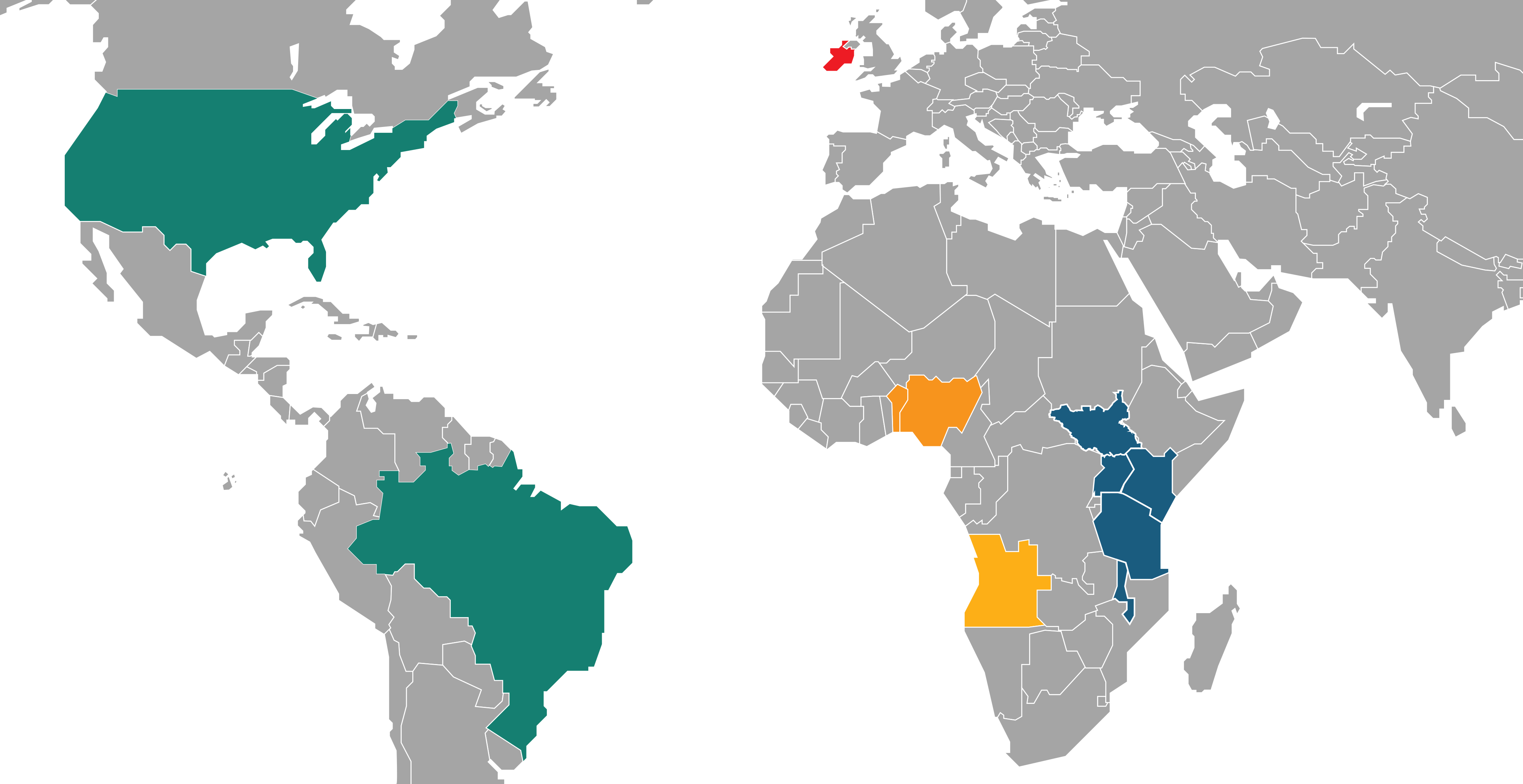
Unfortuntely, the Archbishop was away but our friend of many years, Bishop Lisane Christos came. Our co-worker in mission, Fr. Martin Kelly CSSp said an opening prayer. Sister Carol recalled the MMMs who served in places people would recognize like Jinka, Gambo, Borena, Mikke, Metcha, Bisidimo, Wolisso, and Addis Ababa. The missions where we served are shown in red on the above map.
Sister Carol said part of missionary life is planting a seed and moving on and we were happy to pass over our projects to others who were committed to carrying on the work. In Addis Ababa we have been privileged to return St. Mary’s Laboratory to the care of the Daughters of Charity and hand over the Counselling & Social Services Center to the Brothers of Good Works.
She thanked our partners who supported us with funding and the many groups that facilitated the work. ‘It is not easy to leave’, she said simply, ‘but it gives me hope knowing that services will be continued by the Brothers and our staff who are so committed and have been so supportive.’
It was moving to hear the staff and clients who then spoke of how they had been helped – one with polio now having completed a degree and holding down a job, married and expecting their first child, another HIV positive client who had been very ill, but now has a home and family and is very happy.
Bishop Lisane said the blessing before the meal, after which he, Abba Girma, Brother Hugo and Sister Carol cut the cake specially made by the Catholic Archdiocese Women’s Promotion Center. Many gifts were presented, including a treasured picture of the staff. It was a truly memorable day.
Click here to download the Review of MMM Counseling and Social Services Center, A Lessons Learned and Documenting Exercise. The review was carried out in February and March 2010 by Dr. Eamonn Brehony (pdf 431k).
Perceptions of Child Sexual Abuse
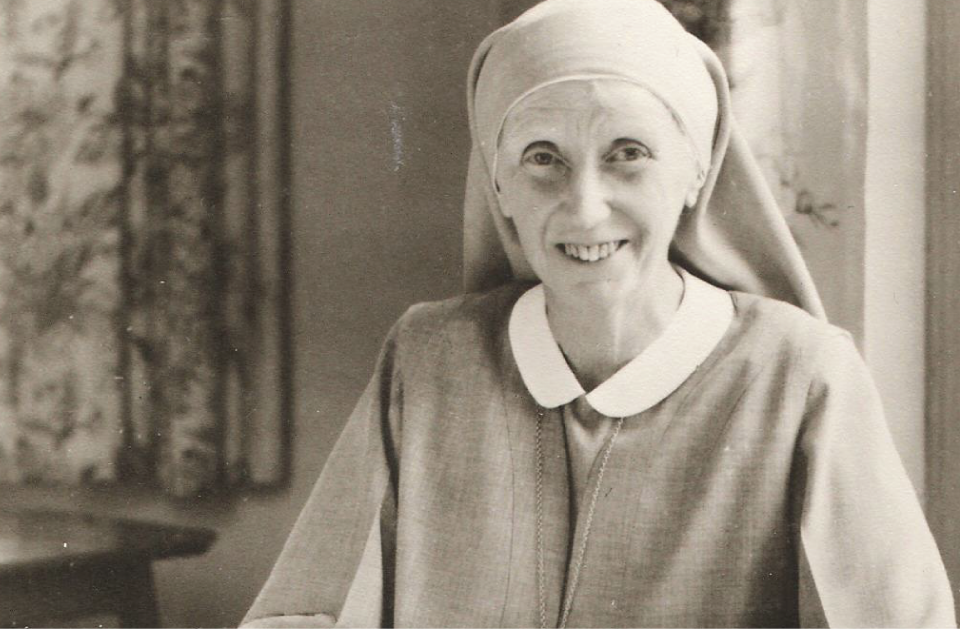
Sister Margaret Hogan (left) has been lecturing in the Department of Clinical Psychology at the University of Dar es Salaam for many years. Right now, she is extra busy but work continues to be life-giving, she says.
Early in July she flies to Nairobi to make a presentation at a Conference on psychotrauma. Her paper is about developing skills to improve the outcome of trauma.
By July 19 she will be on the island of Zanzibar, training Primary Health Care workers in government facilities on the basics of Cognitive Behaviour Therapy.
The really big news is that they are - after much effort - approved to start a Master’s Program in Clinical Psychology, the first in Tanzania. Margaret has been busy preparing the curriculum, with a group from San Francisco doing curriculum review, all competency focused.
She has recently been supervising a doctoral student and working with a group of researchers on Perceptions of Child Sexual Abuse. The first of two most interesting and helpful articles has been published recently in The Journal of Child Sexual Abuse. A second article is in the press.
The specific aims of the study were to describe the roles of various key players handling Child Sexual Abuse (CSA) cases, to explore the factors that facilitate or hinder just/fair handling of CSA cases and to discuss possible changes for improving the legal system’s handling of CSA cases.
This is a qualitative study using interviews with key informants to capture their experiences of managing sexual offences involving children. It looks at laws pertaining to sexual offences involving children, reporting a sexual offence and the role of NGOs in legal matters.
Five themes and 20 categories corresponding to specific research questions were derived from the analysis of interviews carried out. It is evident from this study that a huge deal of work remains to be done in order to safeguard children.
This research will be of great interest to anyone involved in the area of child protection in sub-Saharan Africa. For copyright reasons, we are not at liberty to circulate the publication generally, but it is available to those working or studying in this field.
See Kisanga, Felix , Mbwambo, Jessie, Hogan, Norah, Nystrom, Lennarth, Emmelin, Maria and Lindmark, Gunilla (2010) 'Perceptions of Child Sexual Abuse—A Qualitative Interview Study with Representatives of the Socio-Legal System in Urban Tanzania', Journal of Child Sexual Abuse, 19: 3, 290 — 309.
Pilgrimage to Rwanda
Visiting Lourdes, Dr. Russell Brynes was fascinated by the way Rwandan women were dancing in front of the statue of the crowned Virgin. He tells us:
Their prayer was so spirit-filled that when they told me of the shrine of Our Lady of the Word in Kibeho, Gikongoro diocese, Rwanda, I immediately decided to visit there. I came home, read some books, checked out some websites, and wrote an email in basic schoolboy French to the Marian Fathers in Kibeho booking a room at their hostel. Everything was arranged.
Then the Holy Spirit introduced me to Sister Helen! I was talking at a neighbouring parish, just three months before I was due to fly to Rwanda when I saw a newsletter from the Medical Missionaries of Mary in Kirambi thanking the parishioners for their assistance. Sister Helen’s parents live in the parish, and I wrote her a letter suggesting that I ‘pop in’. Kirambi was not far from Kibeho on the map - surely no more than a bus ride. It seemed like a good idea to visit, as some English speaking company may be welcome after a week alone.
In the gentlest, kindest way Sister Helen very sensibly suggested that a week’s holiday in a middle class suburb of Cape Town some years ago probably had not prepared me for Africa. Her solution was to meet me at the airport, take me to Kirambi for a few days before driving me to Kibeho and back before getting me to Kigali in time for my return flight.
Such kindness was typical of the approach the Sisters have to all those in need, as I saw in Kirambi. They welcomed me with great generosity into their home, sharing their work, their prayer, and their meals with me. The village of Kirambi is three hours from Kigali, the last hour or more on a rough dirt track, pictured above. In the past there was a shorter route but part of the road collapsed and has not been repaired…Although I am not sure how I will find the time, I would like to go back one day and this time provide some help and assistance to the Sisters in their valuable work.
To read Dr. Brynes’ account of what he saw and experienced in Kirambi, click here.
Media Coverage of Africa
Jack Breslin is a professor in the Mass Communications Studies Program at Iona College in New York. He acknowledges that his personal interest in Africa originated with his sister Carol, who has worked for more than 25 years as an MMM doctor in Nigeria and Ethiopia (They are pictured here in Addis Ababa). He says:
"Having visited her in both countries, I have learned to appreciate the African culture, people and heritage. To call these experiences 'life changing' would be an understatement."
In a recent article in The Journal News – published by a multimedia company serving the Lower Hudson Valley - Dr. Breslin challenges American media for their lack of coverage of the continent of Africa.
"With World Cup fever gripping the globe, all eyes are turned toward South Africa. So for the next few weeks at least, the American news media and their audiences will be aware that the African continent exists.
"Unfortunately, the rest of the time, the news media's attention is focused elsewhere since few daily African events or issues seem worth reporting. As a result, the American public knows or cares little about this vast continent, its diverse cultures and 1 billion people."
He is critical of the fact that AIDS in Africa has been dropped from the news agenda – even though the disease still rages at a pandemic level. Dr. Breslin has returned to Africa many times, taking groups of students from Iona College, and he recommends this experience.
"Although this year's trip was shortened by volcanic ash delaying our departure, the students enjoyed a packed schedule of helping in primary and secondary classrooms, visits to students' homes, cultural and historical sharing, and nature trips.
"Such a cultural immersion experience should be required for every American high school and college graduate. In two short weeks, those 12 students opened their eyes, hearts and minds to a new continent, culture and people. Meeting their peers in another land helps broaden perspectives, destroy stereotypes and build understanding on both sides of the world."
To read the full article click here: www.lohud.com/article/20100625/OPINION/6250317/Africa-deserves-media-attention-year-round
If you would like to support MMM with a financial contribution, click here for our Online Donation form.
|