Friday, 03 September, 2010 Donate Online


MMM Communications,
Roswmount, Booterstown,
Co. Dublin, IRELAND.

Mission Development
4425 W 63rd St., Ste 100
Chicago, IL  60629-5530


Deutsch | Swahili | English | Français | Português | Español | Tagalog | Malti


Reply

Unsubscribe

Tell a friend

MMM Communications, Rosemount, Booterstown, Dublin. Ireland.
Tel :353-1-2887180 Fax:353-1-2834626 e-mail:
mmm@iol.ie
Issue No. 96, June 2010

Battling the Demons of Discrimination

Dear Friends,

This month I write to you from Geneva where the UN Commission for Human Rights has been marking the 10th anniversary the Palermo Protocol - adopted by the UN General Assembly to prevent, suppress and punish human trafficking.
 
Below, I have tried to summarize a few of the key points made about this problem that stretches from Malaysia to Mexico, from Norway to New Zealand, and everywhere in between. Human trafficking affects us all.
 
The first morning, I wandered into the wrong Conference, and found myself listening to the challenges which are presented to Development by Migration. It argued for the mainstreaming of the issue of migration in all development policies.
 
In 2010 the estimated number of international migrants will reach 214 million. That means one person in every 33 has moved from their country of origin. In addition, 26 million people have been displaced internally. Disasters related to climate change have been responsible for the displacement of 20 million people. The number of refugees is put at 14 million.
 
Most States lack the capacity to manage migration effectively, they said. While most migrants contribute positively to the receiving country and often to their sending country as well, graphs showed how unemployment rates have grown faster for migrants than for nationals.
 
Back at the Seminar on Human Trafficking, the UN High Commissioner for Human Rights, Ms. Navanethem Pillay, reminded us that human rights law has battled ‘the demons of discrimination’ on the basis of race, ethnicity and sex; it has established key rights for aliens; it has decried and outlawed arbitrary detention, forced labour, debt bondage, forced marriage, slavery-like practices and the sexual exploitation of children and women; and it has championed freedom of movement and the right to leave and return to one’s own country.
 
All these problems can seem too big to handle when considered globally. But at a local level each of us can do something. Below, our Congregational Leader, Sister Siobhan, reminds us that our task begins when our experience of God is turned into prophetic action.
 
Sister Anna Finnegan puts her reflection in a poem, inspired by her surroundings in Haiti. And writing from the city of Salvador in Brazil, Sister Sheila Campbell believes that if each person we serve finds someone to care, to believe in them, to open possibilities of a different life, then our missionary work will be well done.

Please pray for us as we try to make things better for those we can reach.


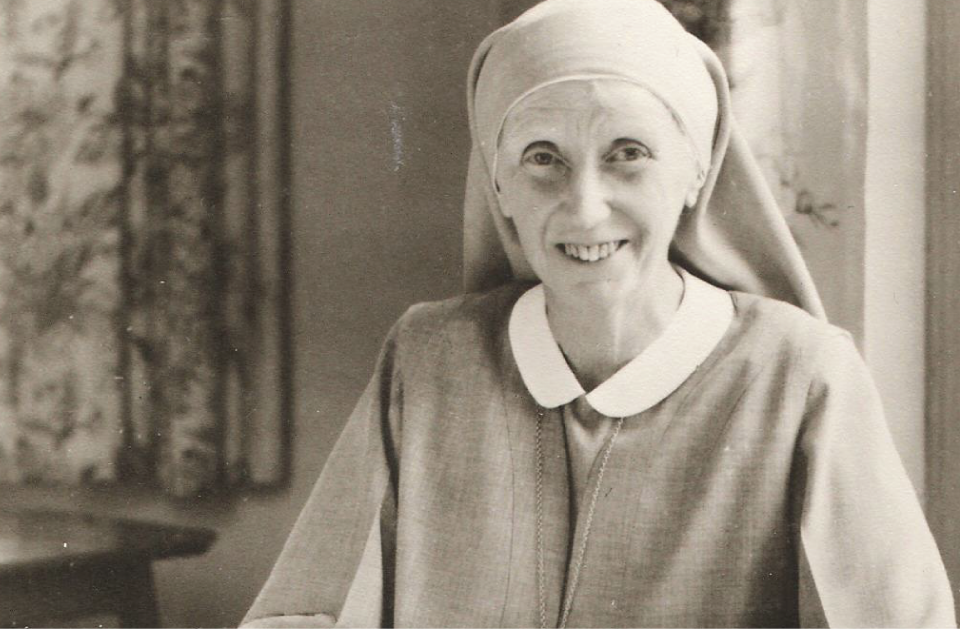
Letter from our Congregational Leader

As I write, we are in the week between the Feast of Pentecost and MMM’s big Feast – the Visitation.  I have been pondering on the Word of God and wondering what I should share with you. Then I recalled the privilege of participating in Rome last month at the Conference of the International Union of Superiors General. 
 
Along with 800 other Congregational leaders I was inspired by papers from many speakers. Among them was Juedette Gallares, RC who spoke to us about “Opening the Heart to Listen; Becoming Mystics and Prophets Today”.
 
She invited us to imagine Mary and the women gathered in deep prayer with the apostles and disciples as they awaited the birth of a new beginning, a new Pentecost—the birth of the Church.
 
She suggested that we understand mysticism as the “spirituality of the direct experience of God”, a kind of knowing which goes beyond intellectual understanding. It was this particularly unique mystical experience of those gathered in the first assembly that brought about the explosion of the Holy Spirit in their midst.
 
She went on to remind us that we see from the Gospels how the disciples in the Early Church came to realize more profoundly the relationship between contemplation and action, between mysticism and prophecy:
 
 “Their direct experience of God loosened their tongues to proclaim the power of God in their lives and in history, impelling them to go out and to fear no longer in proclaiming the good news and in giving witness to the Spirit of Jesus to peoples and in places needing God’s healing and transforming message.  We can therefore say that Christian mysticism is about nothing else but the transforming union finding its deepest expression in the following of Christ in prophetic witness and mission.”
 
It is marked by love, true understanding and acceptance of one another and brings about fruitfulness in the mission. 
 
Just as the mystical experience of those gathered in the upper room cannot be confined within its walls, so also our mystical experiences as MMM Sisters and Associates and all those who share our charism can be transformed into prophetic action by our living in the spirit of the Visitation.
 
Mysticism and prophecy is our way of life. We gaze at God and gaze at the world with the eyes of God. If we give ourselves wholeheartedly to this, we too will be impelled to go out and to fear no longer in proclaiming the good news and in giving witness to the Spirit of Jesus to peoples and in places needing God’s healing.

Mountain Hill

Today I went to visit the women who live and work in prostitution on the Ladeira da Montanha, or, as we would say in English, Mountain Hill.  I realise the name is certainly correct, as I puff my way up and down the street. This is one of the oldest streets in Salvador, linking the lower city, the area around the port, to the upper city where the main cultural and business life of the city thrives.
 
Mountain Hill was built by slave labour in the nineteenth century. Years ago it was noted for its luxurious night life, cabarets, bars and discreet brothels.
 
Nowadays it is a completely different scene. Few buildings remain that rotting wood, rain and time have not destroyed. Even the “intact” buildings have leaking roofs, unsteady floors and look on the verge of collapse. Nothing has been painted in this century anyway! 
 
In place of the bygone luxury, the most degraded brothels of Salvador have taken over. Drugs - particularly crack - have wreaked havoc on the local population.  The women resort to drugs and alcohol as a means of numbing themselves from the hardship of life in prostitution. 
 
Today I met Maria, a 34-year-old mother with 7 children to feed.  She told me that she comes to work on Mountain Hill two or three times a week, but only during the day when the kids are in school.  “Someone has to put bread on the table!” 
 
Then there is Lelia, a woman in her early fifties. She was brought to the Hill when she was a teenager after running away from the family home.  “Where else would I go? I like it here, with my friends, my colleagues.”   She is in treatment for cancer and is presently in remission, but asks me to monitor her health as she has nowhere else to go if she gets sick.
  
The health of these women is indeed my concern.  Many have sexually transmitted diseases that you would expect in this work, but also stress-related illness like hypertension and gastritis.  Tuberculosis is not uncommon, and HIV/AIDS. 
 
But most importantly I give acceptance, attention and care.  I am there to listen, to promote self-esteem, to encourage.
 
Do I enjoy my afternoons with these women?  Yes, I love it!  And it is not all one-way attention. They look out for me and protect me from the thieves and muggers who travel up and down the Hill, calling out, “Don´t touch her, she comes to visit us!”
 
Prostitution in Salvador may never end, but if each of these women finds someone to care, to believe in them, to open possibilities of a different life, then I think our missionary work will be well done

Human Rights and Human Trafficking

Milka was born Kenya in 1983 and raised by her grandmother until she was eleven. Then a couple offered to get her a good education in Germany. Her grandmother believed them and so began her experience of coercion, trickery and vulnerability. Forced to be photographed nude, she was placed for ‘training’ with older women, then forced into prostitution serving older men who would beat her. She was later trafficked to Mexico City, where her new ‘owners’ made good money from her ‘work’.  Then one day she was blindfolded, put in a truck and smuggled into the US, where she was forced into prostitution in Washington, DC.
 
By the time she was rescued by a project that goes searching for victims of trafficking, she was pregnant, suffering psychologically with depression, feelings of desperation and uselessness. She was referred to the Second Chance Employment Services – a not-for-profit agency which put her in touch with a lobbyist from a faith-based organisation who took her in to live with her until the baby came, then helped her find a lawyer to secure a visa, provide clothes, transportation and child care, and eventually enrolment in University where she was successful.
 
Second Chance Employment Services was one of many agencies who shared experiences of best practice at the UN Seminar in Geneva last week. Milka’s captivity, several people commented, was quite typical of so many women who leave home to pursue a dream only to end up in a nightmare. She was lucky enough to be rescued.
 
UN High Commissioner for Human Rights, Navanethem Pillay (right), told the gathering that it is important to bring the voices of survivors into the discussions. Howeveer, taking a human rights based approach to this problem is only possible when victims have been identified, and the difficulties of identification were underlined. There is not even a common definition of ‘victim’ in relation to human trafficking.
 
Research is needed to better understand the extent and impact of the problem. While poverty is often mentioned as one of the ‘push’ factors, it should be seen as a context rather than a cause of trafficking. Among the ‘pull’ factors, the question of such extensive demand for these services was frequently mentioned. Many governments are unwilling to make this link.
 
The Egyptian delegation cited the work of the Suzanne Mubarak Women’s International Peace Movement which includes working with the world of business to tackle the situation and bring about a code of behaviour in this sector, similar to work that has already begun to engage the tourist industry in the battle against human trafficking.
 
For more see:
Second Chance Employment Services  (www.scesnet.org)
Women's International Peace Movement (www.womenforpeaceinternational.org)
UN High Commission on Human Rights (www.ohchr.org)

Extreme Unction 

Disaster, destruction, decay,
Haiti, why should it happen this way?
Those thirty-five seconds - in the blink of an eye
buildings toppled and thousands die.
 
Walls have fallen, roofs have gone,
buildings, like shells, falling down.
People screaming, ‘who is left’,
Scrambling around, alone and bereft.
Bodies buried in rubble and rock,
drillers striving to raise them up.
Parched and hungry, waiting for food,
so many obstacles, dark interludes.
 
Like living in death, in the depth of the tomb,
yet hands are anointing and easing the doom.
Spirits are lifted, life must go on,
‘We Are His People’ they are singing this song.
Young people talking, they cling to their phone,
with music and chatting and life in their bones.
‘Digicel’ remains high in the sky;
we connect with each other, our hopes never die.
 
Fresh trees are glistening in the heat of the sun,
washed with tears from everyone.
Fruit in abundance is ready and ripe.
He is among us to make it alright.


If you would like to support MMM with a financial contribution, click here for our Online Donation form.


If you liked this Newsletter, please Tell a Friend and share the good news.
Thank you for being part of our MMM Extended Family.


Last modified: Tuesday, June 1st, 2010

 
MMM Forum © Medical Missionaries of Mary 2010 - Powered by eWrite - Printer Friendly
Ireland: CHY 7150 UK: MMM Trust 293494 In USA we are a tax exempt 501 (c) (3) organization.