Thursday, 09 September, 2010 Donate Online


MMM Communications,
Roswmount, Booterstown,
Co. Dublin, IRELAND.

Mission Development
4425 W 63rd St., Ste 100
Chicago, IL  60629-5530


Deutsch | Swahili | English | Français | Português | Español | Tagalog | Malti


The Benedictine Way of Life: A Personal Testimony

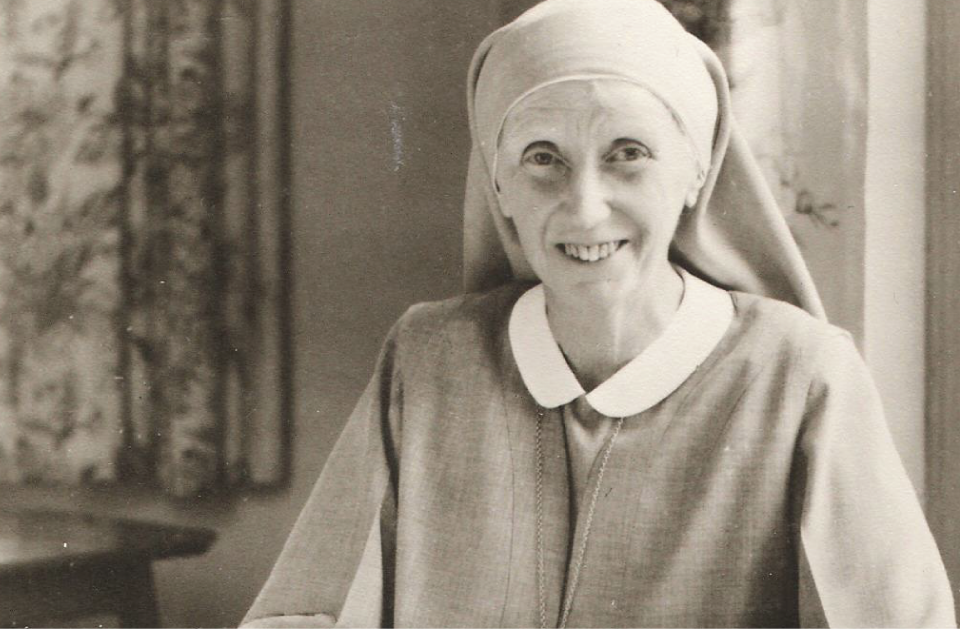
 by Sr. M. Magdalen O'Rourke MMM Sister Magdalen O'Rourke, founding member of MMM

Mother Mary Martin, our Foundress, desired and ardently stressed many times how much she desired that the Congregation she was founding should be deeply rooted in the Spirit of Saint Benedict's Rule. She saw the broad spirit of the rule. Its flexibility to adaptation contained the deep spirituality and freedom of spirit which she desired and saw as essential.

She envisaged the new Congregation as being contemplative and at the same time being very active in the medical apostolate. The choice is still meaningful and we drew on that inspiration in writing our new Constitutions in 1979.

Mother Mary Martin, Foundress of MMMWhen I met Mother Mary in 1934 and volunteered to join the first group, she told me that we would follow the Rule. I didn't know anything about St. Benedict except the power of his medal. I got myself a copy of the Rule and I was completely turned off. It was all for monks and sounded very austere at first reading. However, I was fortunate in that the first group of MMMs were privileged to live in the newly founded Monastery at Glenstal, Limerick. It was a Priory then, not yet an Abbey, where we got our formation.

It was indeed a privilege to see at first hand the life being lived by a dedicated, committed and ascetical group of monks. It was perhaps their example more so than the instructions we got that meant so much to us.

I soon learned that St. Benedict was not just an austere legislator but a loving Father. I saw that the MMM lives were being inserted into a living tradition and not based on a past that is gone. But something of the past is still alive and open to the future, challenging us to life. Being solidly founded on the Gospels, it was to give us that challenge and inspiration.

SEEKING GOD
The first question we seemed to be asked when we came was 'Are we really seeking God?' We realised that God first called us and the call was ongoing every day and if we listened to that call with the ears of our heart, as St. Benedict said, we are open to live the gift of the Spiritual Life to the full. We saw how Mother Mary herself answered that call and was always seeking God in accepting all the events and circumstances of each day and especially in the disappointments, Crosses and delays in her founding days. Truly seeking God was what our healing apostolate was to be all about. In seeking God we take the spotlight off ourselves and thus find God and ourselves and live for others.

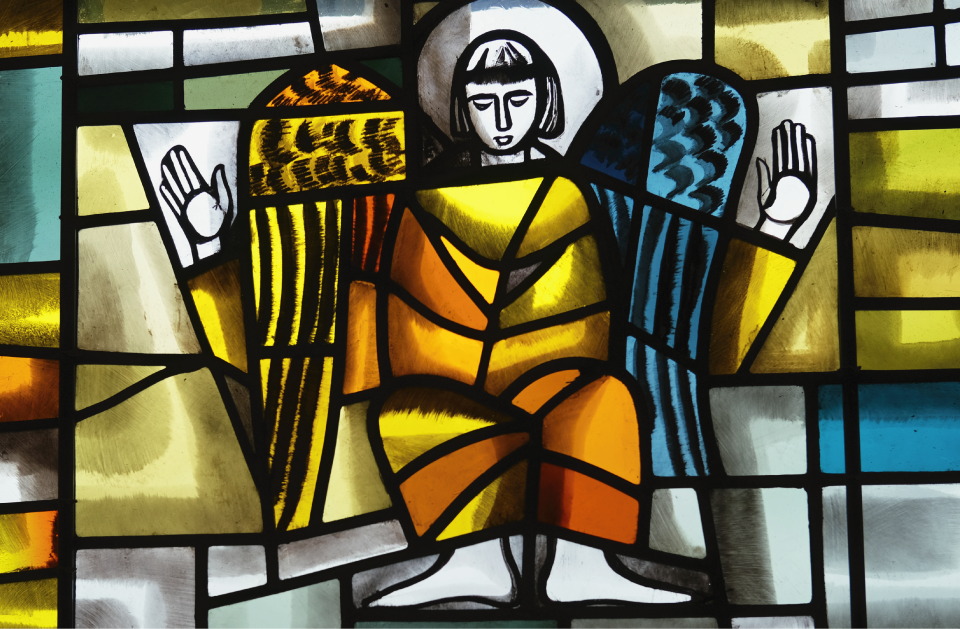
Stained Glass Window of St. BenedictWhat appealed to me was that we were to live the oft repeated phrase of the Rule 'To prefer nothing to the love of Christ'. St. Benedict himself was 'A Christ man' as might be said of Mother Teresa of Calcutta to-day that she is a 'Christ woman. The Benedictine Life is ordered by the love of Christ.

The continuous Sacramental encounter with Christ in persons, in the poor, the sick, the Abbot, the guests etc., became a dialogue of listening and responding. Humility and obedience, which Mother Mary always wanted to be central in our lives, became easy with the slogan 'It becomes those who hold nothing dearer to them than Christ'. We might say it was St. Benedict's watchword in all things. He made it his last exhortation to his children: 'Let us prefer nothing whatever to the love of Christ and may He bring us all together to life everlasting'.

PRESENCE OF GOD
Living in the presence of God runs through the Rule and is at the root of its injunction to seek God in everyone. It was something that Mother Mary always exhorted us to. St. Gregory tells us 'St. Benedict kept his mind in heaven while still on earth'.

Oratory at MMM Inter-cultural Novitiate, Nairobi This awareness of God is, after all, what contemplation is all about. The most vital gift of all for the individual and the Church is this gift of prayer. I saw that the contemplative vision gives rise to our apostolic activity. St. Benedict gives us a harmony and a wholeness which is much sought after to-day.

LITURGY
It was our privilege in Glenstal to share in the Liturgy with the monks, but not fully owing to the demands of our work in the School and the Monastery. We were enthralled with the Gregorian Chant, but we had to realise while we got a great appreciation of the Divine Office and with the reverence and precision with which it was performed, that we would have to sacrifice this in our active missionary apostolate. We learned to participate fully in the Liturgical Cycle and we read the readings of the next day's Mass and the commentary the previous evening. The Opus Dei for us was to be our active healing apostolate.

STABILITY
I found it hard to reconcile the Vow of Stability to our active missionary apostolate where we would be very much on the move. I soon learned that 'stability' for us meant 'standing still to the inner self and internal unity and cohesion' not running away from myself. St. Benedict says 'We can so easily drift to the sloth of disobedience. I saw that it means commitment and fidelity and persevering in patience, in holding on to our Benedictine tradition and our own wholesome traditions'. To-day we can so easily fall for new spiritual fads and what appears to be modern. I could see the two great Benedictine virtues, balance and discretion play a great part here. I can see this also applied to conversion which means being open to change, not clinging, not holding on to what is safe. We have got to stand still and we have got to move. We are to be people on the run which sounds a bit of a paradox. Conversion to us is seen as a turning round. Very often this means a return to the basics of religious life and the charism of our Foundress, a commitment to a radical following of Christ. Conversion is simply a facing up to the demands of growth and change with total dependence on grace as St. Benedict reminds us in the Prologue 4.1.

These are only a few facets of the Rule where I see MMM getting our inspiration and have no problem in living the Benedictine way of life.

BENEDICTINE OBLATES

It is interesting that one of our first group who had to leave for health reasons, got married and became an Oblate, and had no difficulty in following our Rule of life as in Glenstal. She found no problem in keeping up the Divine Office of morning, evening and night prayer, having that bond of unity with the Church praying all over the world. For her, it was living out of the Gospel values in the Rule of St. Benedict, and she saw it meant challenging many of the values of contempoiary society. She learned to live simply in a consumer society with respect for material things. It was difficult for her to be a listening person without the help she had in Glenstal, especially silence. Living a busy life of battering noise and endless demands she had to try to make silence a priority to keep that contemplative vision within in the midst of the mundane. Her Opus Dei now was looking after her home and family and her work of evangelisation in the Legion of Mary. Alice was so proud to be a Benedictine Oblate, that when writing to us she always put O.S.B. after her name. She was privileged to·be buried in the monks' cemetery at Glenstal.


Last modified: Tuesday, June 15th, 2010

 
MMM Forum © Medical Missionaries of Mary 2010 - Powered by eWrite - Printer Friendly
Ireland: CHY 7150 UK: MMM Trust 293494 In USA we are a tax exempt 501 (c) (3) organization.