Thursday, 09 September, 2010 Donate Online


MMM Communications,
Roswmount, Booterstown,
Co. Dublin, IRELAND.

Mission Development
4425 W 63rd St., Ste 100
Chicago, IL  60629-5530


Deutsch | Swahili | English | Français | Português | Español | Tagalog | Malti

MMM in Nigeria

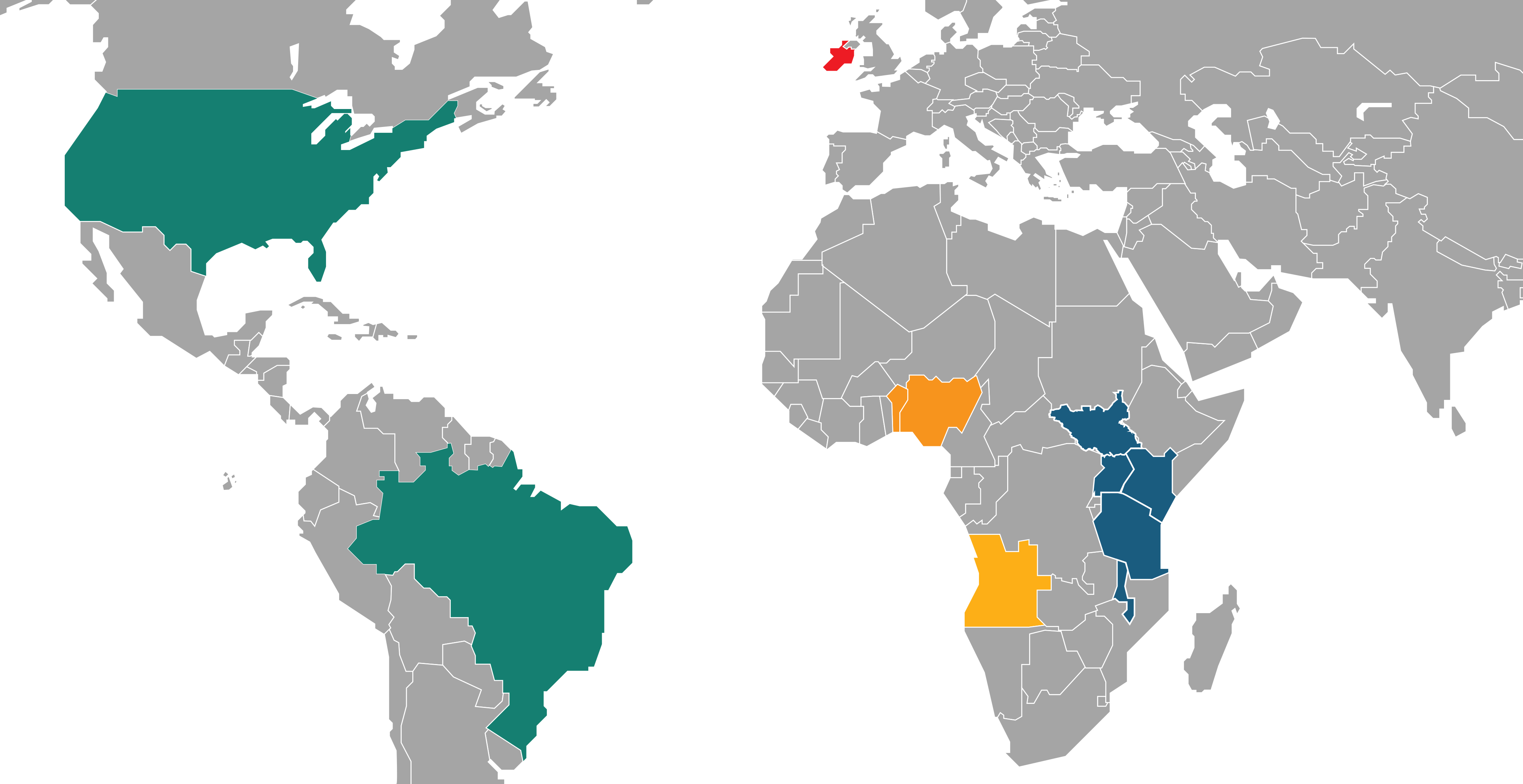
Nigeria

Map of Nigeria

Land: 910,768 sq km
Coastline: 853 km
Population: 149,229,090
(July 2009 estimate)
Age Structure: 0-14 years: 41.5%
15-64 years: 55.5%
65 years and over: 3.1%

(2009 estimate)
Life Expectancy: male: 46.16 years
female: 47.76 years
Infant Mortality Rate:
94.35 deaths/1,000 live births
People living with HIV/AIDS:
2.6 million (2007 estimate)
Literacy: Total population: 68%
male: 75.7%
female: 60.6%
(2003 estimate)
National Holiday:
Independence Day, (National Day)
1 October (1960)
From - World Factbook 2009

In the past 73 years, MMMs have seen many developments and changes in Nigeria.

Today we are involved in health care at 9 different locations. We have three hospitals. One is at Eleta in the city of Ibadan in Oyo State. Another is at Urua Akpan in the State of Akwa Ibom. The third is at Mile Four, just outside Abakaliki, in Ebonyi State.

At Itam, which is also in the State of Akwa Ibom, we have the Family Life Center, established by Sister Ann Ward who pioneered the cure of women suffering from vesico-vaginal fistula. This is a residential Unit, as the cure usually requires several separate surgical interventions. Today, another MMM surgeon, Sister Mary Molloy, is in charge at Itam.

Elsewhere we are involved in community based health care, training of Traditional Birth Attendants, control of diseases such as TB, leprosy, measles and other illnesses to which the population is particularly vulnerable. As in all countries, a considerable amount of effort is devoted to the effects of the AIDS pandemic.

We have a multi-cultural Novitiate at Ibadan. Many professed MMM Sisters who come from Nigeria are working as missionaries in other countries.

Back in 1921, when our foundress took a canoe up the Cross River from Calabar and then trekked on foot the rest of the hundred-mile journey to Onitsha, she saw the teeming multitudes of people without health care. That inspired her to return to her home in Ireland and look for companions who could help her address the needs.

Many decades later, her inspiration is still with us as we labor in places as far-flung as the remote village of Fuka among the nomadic Fulani herdsmen, to the city of Benin where we try to prevent young women from being lured overseas to become victims of human trafficking. Our hospitals at Eleta on the outskirts of the city of Ibadan, at Mile Four near Abakaliki and in Urua Akpan further south, take a lot of funding. Likewise our specialist unit for the repair of obstetric fistula at Itam in the south-east.

Please help us if you can.

Stories from MMM in Nigeria

Goodbye to Gussoro  by Sister Sylvia Ndubuaku
Nigeria, 2008:  Gussoro, made up of twelve villages and seven hamlets, is surrounded by the Kaduna River on the north and west. There are only two routes you can take, one that leads south, and the other that ends in the river.

The river serves as a source of income through fishing, a source of recreation through swimming, a source of drinking water, a means of washing dresses, dishes, sleeping mats and other washables and as the main route to other nearby villages and towns. Gwari is the name of the tribe in the area. They are mainly farmers.  >>> more.

Capacity Building in Minna Diocese
 Nigeria, 2008:  The 21-person Health-Care Team co-ordinated by Sister Gladys Dimaku includes 7 Nurse-Midwives, 3 Community Health Extension Workers, a Monitoring and Evaluation Officer, a Coordinator of Services for Orphans and Vulnerable Children, a Training Coordinator, 2 drivers, 2 accountants, as well as other support staff.
Their work takes them to many outposts in the six deaneries of the Diocese, the most distant deanery being a three-hours drive, close to Kaduna. This usually involves an overnight stay, providing services and health education on Saturday afternoons and all day Sunday.  >>> more.

Vocational Education seen as Key to Prevention
 Nigeria, 2007:  Sister Blandina Ryan has been greatly preoccupied by the problem of young unemployed women being picked up and trafficked abroad for sex work. When our community in Nigeria reflected on this problem, they felt the best form of prevention would be the creation of Vocational Training. It took a lot of planning and fundraising before the Mother Mary Martin Centre was eventually constructed on the outskirts of Benin city. >>> more.

A Great Dose of Reality - Sister Deirdre Twomey writes from Mile Four Hospital, Abakaliki.
 Nigeria, 2005:  A letter from America caused great excitement here at Mile Four Hospital. In it, Medhat Allam told us:
“I am a general surgeon willing to join hands with you in providing help for poor people in Africa. In 1997, some friends and I started a volunteer medical group that is now registered in New York State as the International Surgical Mission Support (ISMS), a self-sufficient group that raises enough funds to cover annual expenses, providing direct medical care and bringing large amounts of supplies and equipment to help the local doctors at the end of our mission. We have been to different countries and provided surgical care for hundreds of patients free of charge.”  >>> more.

AIDS in the marketplace
 Nigeria, 2005:  The famous Brazilian educator, Paulo Freire, author of Pedagogy of the Oppressed, stressed the importance of spending time among the people, listening carefully to find out what issues were important for them. In Lagos, Sister Felicia Muoneke devised something similar when taking her first steps in tackling the problem of raising awareness about HIV and AIDS. She had already contacted other doctors who – like herself – were anxious about the scale of the problem. >>> more.

Tuberculosis has not gone away - Sister Eunice Okobia writes from Lagos
 Nigeria, 2005:   With the rise of HIV and AIDS, TB has once again become a major problem in Lagos. There is a prevalence of HIV among an estimated 5.9 million people, and half of these are also testing positive for TB. Due to poverty and lack of employment, young women become involved in casual sex and are therefore prone to HIV infection. >>> more.

History of MMM in Nigeria

2008 Annual Report from Eleta Hospital

More Stories from Annals of MMM in Nigeria


Last modified: Saturday, March 20th, 2010

 
MMM Forum © Medical Missionaries of Mary 2010 - Powered by eWrite - Printer Friendly
Ireland: CHY 7150 UK: MMM Trust 293494 In USA we are a tax exempt 501 (c) (3) organization.